Tailwise
The vet said he’s fine.
He still isn’t himself.
The examination happened. The results were normal. And the dog on your couch is still quieter than the dog you remember. This guide is for exactly that gap — the part that comes after the all-clear.
A $27 PDF guide for the owner of an examined, cleared dog who has gone quiet: the likely causes, the myths to skip, and a 14-day re-engagement plan with a simple tracker.
Get the 14-Day Clarity Plan$27 · instant download · refund policy below
Read this first
If your dog’s behavior changed suddenly, or if you have not seen a vet, close this page and make an appointment.
Behavior change is most often physical, and only a veterinarian can rule that out. Not this guide — no guide. A quiet dog can be an uncomfortable dog, and there is no way to know from the couch.
This guide is for the dog who has been examined, whose results were normal, and who still isn’t himself. If that is not your dog yet, one appointment from now, it can be. This page will still be here.
At some point you searched “Is my dog depressed?”
Probably late at night. Here is the honest answer, and it is better news than the search results made it sound: “depression” is not a diagnosis dogs receive. What you are seeing is a cluster of real, observable changes — doing less, engaging less, sleeping more — and that cluster is a signal, not a condition.
A behavior change can mean pain or illness, and only a veterinarian can tell you that. You did that part — it is why the box above lets you keep reading. Which leaves the question no exam answers and no listicle takes seriously:
If his body is fine, what does he need?
Dogs are built from routines, sleep, smells, choices, and company on their own terms. When behavior sinks after a professional has cleared the body, the place to look is the shape of his days — and the shape of his days is something you can actually reach. That is what this guide rebuilds, deliberately, over fourteen days.
What this is — and what it is not
This is
- A guide for after the vet visit — the all-clear is the starting line
- The likely reasons an examined dog goes quiet, in plain language
- A 14-day re-engagement plan: three lines a day, with a simple tracker
- An honest map of who to call if two weeks of structure aren’t enough
This is not
- Not medical: no conditions, no signs to check, no medical claims at all
- Not a way to skip the vet — it refuses to work until you’ve been
- Not a promise about your dog — no honest guide can make one
- Not a supplement pitch — there is nothing to swallow in here
What’s inside
- 1 · Read this first. One page. The box above, kept where it belongs — at the front.
- 2 · Your dog is not depressed — and that is the good news. The reframe: the all-clear didn’t fail to answer your question; it changed it.
- 3 · What changed: the usual suspects. Loss, upheaval, under-stimulation, missing sleep, too much chaos, alone-time trouble, fear, and your own hard months — the honest list.
- 4 · Six things everyone gets wrong. The myths — including the one about comforting a scared dog.
- 5 · The 14-Day Re-Engagement Plan. Day by day: one thing to add, one to remove, one to notice.
- 6–7 · Grief, and being left alone. Two special cases, handled honestly — one of them by telling you who to call instead of selling you a protocol.
- 8–9 · When to escalate, and to whom. Credentials that mean something, the unregulated-trainer warning — and the chapter for you, the owner.
- 10 · Appendices. The 14-day tracker, the who-to-call page, the fine print.
Fourteen days, three lines a day
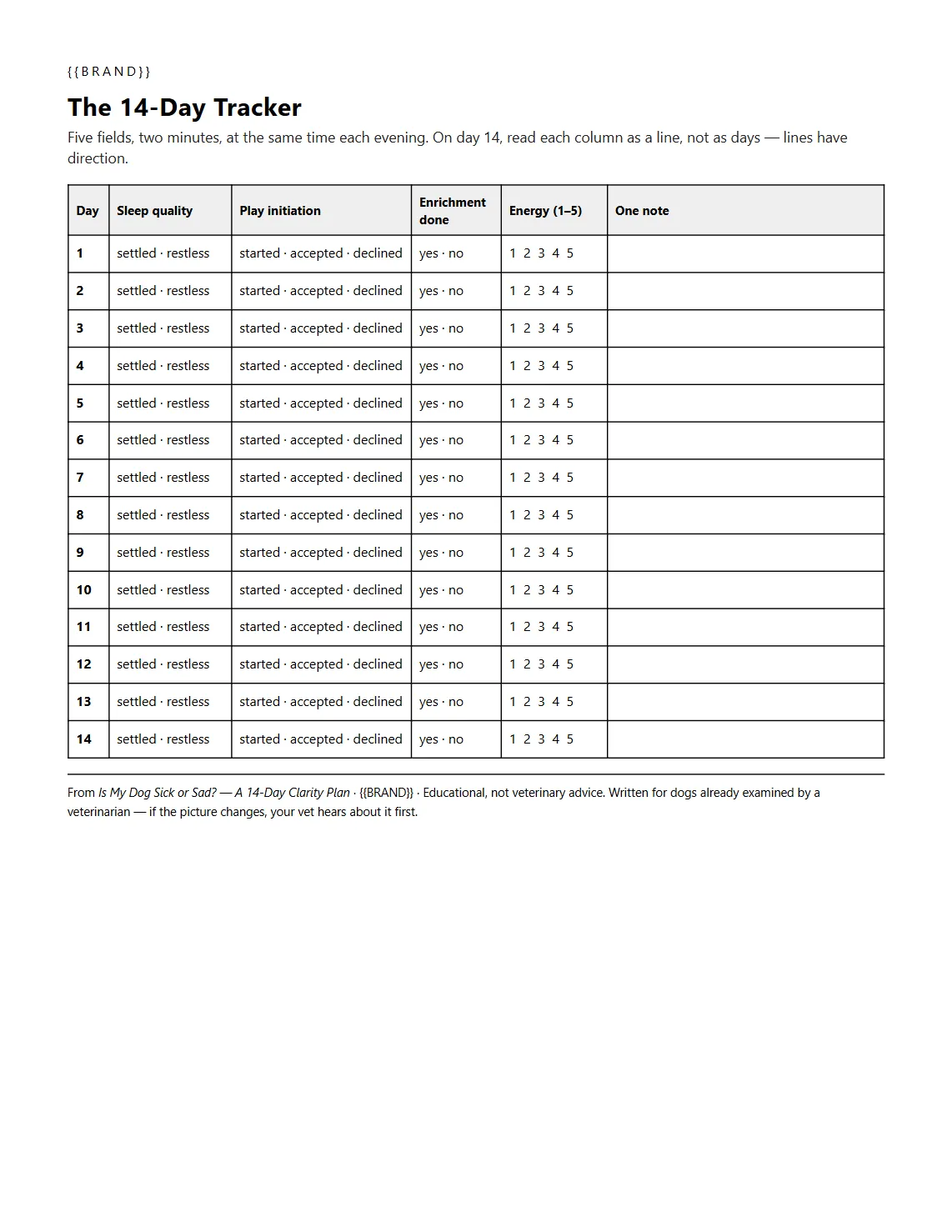
The plan rebuilds four things a flat, withdrawn dog is usually missing: predictable days, protected sleep, work for the senses, and choices of his own. Small on purpose. Boring on purpose. The tracker tells you — in lines, not vibes — whether it is working.
The tools are simple. Look at them.
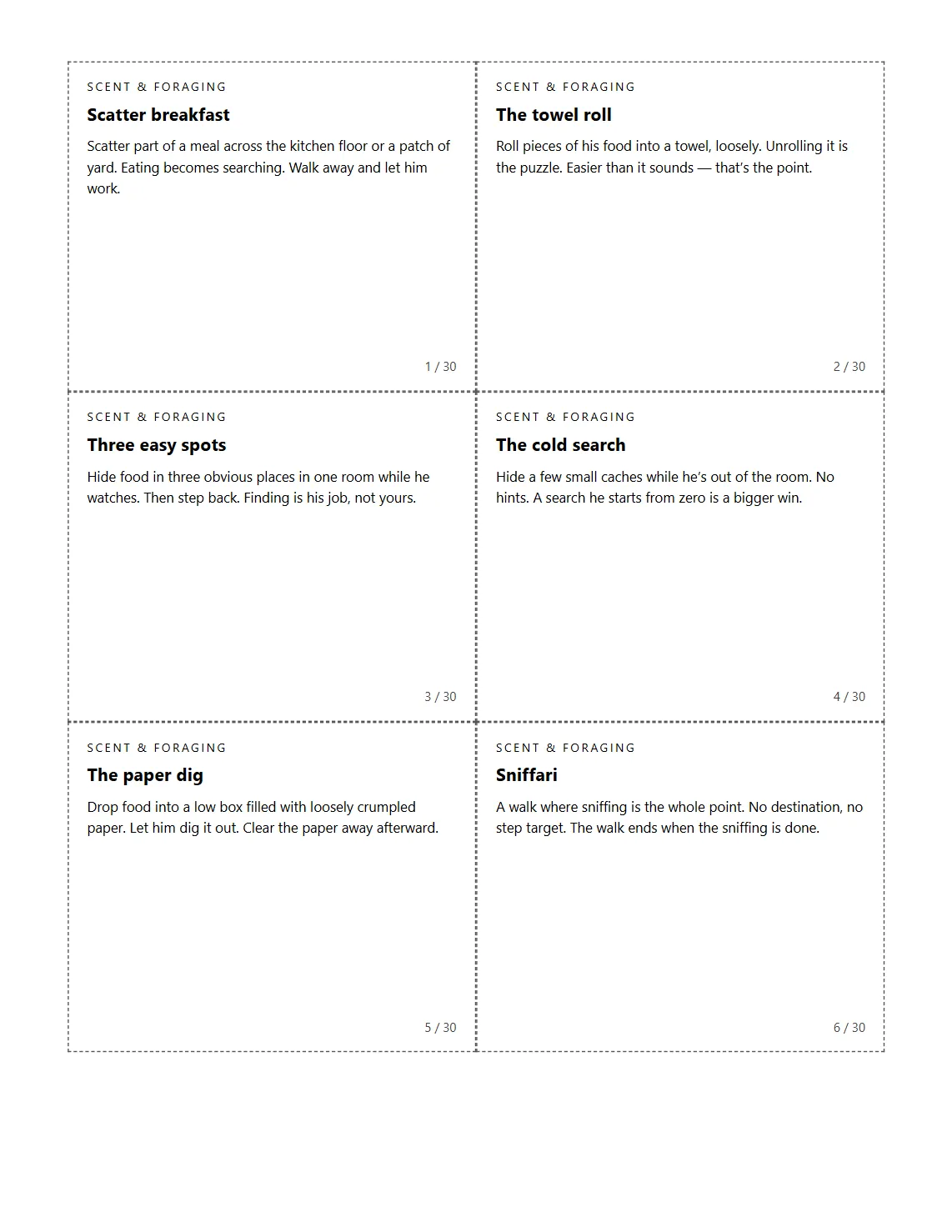
Five fields, two minutes, at the same time each evening — by day fourteen the tracker is how you will know, rather than hope, that something moved. And the optional deck turns the same toolkit into thirty printable cards: one activity a day, cut lines included.
Who this is not for
- A dog who has not been examined by a veterinarian — or whose behavior changed suddenly. That dog needs an appointment, not a PDF. The guide’s first page says exactly that, and means it.
- Anyone looking for medical answers. There are no conditions, no checklists of signs, and no medical claims in this guide — by design. That job belongs to your vet, and in your case it has been done.
- Anyone shopping for a supplement, a hack, or a same-week transformation. Nothing is promised. It is structure, patience, and fourteen honest days.
Get the guide
Tail Up — A 14-Day Clarity Plan
The full guide as a PDF, 35 pages, written to be read tonight — includes the 14-day tracker.
$27
Add the 30-Day Enrichment Deck (optional, at checkout)
Thirty printable activity cards — one low-key activity per card, drawn from the same toolkit as the plan — plus the tracker as a standalone printable. A companion to the guide, ready for the fridge door.
$12
Refunds: if this guide doesn’t help you, reply to your receipt within 30 days and you’ll get your money back. No forms, no questions, no hard feelings. Full policy: refunds.
This guide is educational and is not veterinary advice.
It does not diagnose, treat, or cure any condition, and it is not a substitute for
examination by a licensed veterinarian. This guide is written for dogs who have
already been examined by a veterinarian; a dog whose behavior has changed and who has
not been examined should see a veterinarian before anything in this guide is used.
If you think your dog may be experiencing an emergency, contact a veterinarian or an
emergency animal hospital now.
Tailwise is not a veterinary practice and no veterinarian–client–patient relationship is
created by your use of this guide.
Instant download · checkout by Gumroad · PDF for any device
Questions an honest page has to answer
- Why hasn’t a veterinarian put their name on this?
- Because this guide makes no medical claims for a veterinarian to review — and it assumes a veterinarian has already done that job for your dog, in person, which is the only way that job can be done. There are no conditions named in it, no signs to check, and nothing to self-assess. What it offers is structure for afterward: causes, myths, and a 14-day plan built from low-risk practices widely recommended in applied animal behavior.
- Will this tell me what’s wrong with my dog?
- No — and be wary of anything that says it can. The medical half of that question belongs to your vet and, for your dog, has been answered. This guide works on the other half: what an examined, cleared, still-flat dog usually needs, and how to rebuild it.
- My dog just seems a little off. Is this overkill?
- Maybe — and the guide says so. A change that lasts more than about two weeks warrants a vet conversation regardless of the cause you suspect. If it resolves in a few days, wonderful. The tracker costs you two minutes an evening to know instead of hope.
- Is there anything in here I couldn’t find free somewhere?
- The ideas, no — they’re scattered across a hundred tabs you already have open. What you’re buying is the order: what to rule out of your day, what to add, in what sequence, and how to see whether it is working. Structure is the product. If you have the time to assemble it yourself, you genuinely don’t need this.
- What do I get, exactly, and when?
- Immediately after checkout: the 35-page PDF guide with the 14-day tracker, readable on any device. If you add the Enrichment Deck: thirty printable activity cards plus the tracker as a standalone US-Letter printable.